
The Cultural Imperative: Tactical De-escalation, Policy Volatility, and the Foundational Shift Towards Non-Violent Civil Action in the United States
- null null

- Oct 27, 2025
- 11 min read
The Cultural Imperative: Tactical De-escalation, Policy Volatility, and the Foundational Shift Towards Non-Violent Civil Action in the United States
Introduction: The Dual Crisis and the Mandate for Cultural Transformation
The United States currently confronts a complex, interlocking crisis defined by two primary forms of violence: endemic physical violence, exemplified by the persistent national epidemic of gun deaths, and pervasive cultural violence. This cultural violence manifests as hyper-polarization, toxic political rhetoric, the normalization of antagonism, and systemic policies that reinforce structural inequality.
These two forms of violence are mutually reinforcing elements within a deteriorating social fabric, necessitating a critical shift away from reactive security measures toward proactive cultural and systemic transformation. The core challenge facing policymakers today is the need for a rapid cultural pivot, since current policy frameworks default to rapid physical fortification, particularly in educational environments, while the root causes of conflict—social alienation, psychological distress, and structural precarity—remain unaddressed. This analysis establishes that sustainable solutions require robust structural intervention coupled with the strategic adoption of non-violent methodologies for conflict transformation.
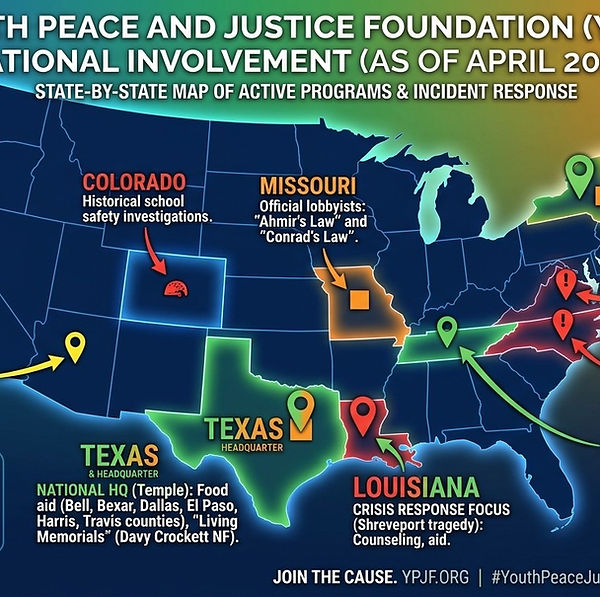
The Youth Peace & Justice Foundation (YPJF), originally established in the aftermath of the 2022 mass shooting in Uvalde, Texas, provides the critical framework for this discussion. Evolving its mandate from localized response to national cultural change, the YPJF addresses the totality of violence—both physical and cultural—across American communities.
The foundation’s core mission is achieved through scalable violence prevention training, youth advocacy rooted in restorative justice, and the empowerment of young people to advance peaceful changes. The foundational principle of restorative justice views violence as a communal wound that requires repair and reconciliation, moving beyond punitive retribution.
The YPJF ambassadors formally issued a "Declaration of Peace," mandating tactical de-escalation and non-violent civil action amidst escalating national instability. This declaration explicitly calls for the mass de-escalation of the current toxic political climate, asserting that American democracy can only flourish when citizens recommit to a peaceful political process, free from the fear of violence or intimidation.
This thesis investigates the empirical evidence supporting the YPJF’s call for this strategic shift. Sustainable violence reduction in the United States requires prioritizing rapid cultural transformation through comprehensive, youth-centered mental health and restorative justice programs, validated non-violent civil action methodologies, and mitigating the structural precarity exacerbated by current politically volatile policies, which consistently fail to address the root causes of conflict.
The theoretical bedrock of this approach is the concept of Systemic Precarity: structural inequalities enforced or ignored by policy create chronic stress and instability, functioning as a mechanism of “silent trauma.” This stress undermines the psychological safety and communal resilience necessary for conflict aversion, contributing directly to the etiology of violence. Addressing this precarity through structural change is essential to ending the cycle of violence.
The Uniqueness of the Youth Peace & Justice Foundation National Model
The YPJF’s model is distinct in its comprehensive, national framework that rejects conventional, reactive approaches. This uniqueness rests on three pillars: a trans-scalar scope that evolved from localized tragedy response to driving national cultural change across all forms of violence; adherence to the primary prevention model, prioritizing root-cause intervention (culture) over the pervasive control models (fortification and policing); and the strategic fusion of restorative justice and tactical de-escalation. This fusion equips youth not only with the ethical lens of reconciliation but also the tactical tools of non-violent engagement to safely and effectively de-escalate conflict in their daily lives and in the political sphere.
The Etiology of Violence: Structural Roots, Systemic Stress, and Acute Manifestation
The urgency of the YPJF’s cultural shift is underscored by the structural epidemiology of gun violence. Firearm homicide data reveals a crisis that is acutely concentrated, functioning as a profound marker of structural failure. Gun violence operates as a structural determinant of health, placing an overwhelming, disproportionate burden on communities of color. In 2021, Black Americans faced a firearm homicide risk nearly 14 times higher than their white counterparts. Young Black males (ages 15-34) comprised only 2% of the U.S. population yet accounted for 36% of all firearm homicide fatalities that year, establishing gun violence as the leading cause of death for this demographic.
The implication is that violence is a predictable outcome of deeply ingrained, structural conditions—such as economic disinvestment and unequal opportunity—that must be systematically addressed.
This crisis is amplified by systemic policies that inflict widespread psychological harm. Punitive structural policies, especially those related to immigration enforcement, are recognized by mental health professionals as primary drivers of mental health morbidity.
Aggressive enforcement practices generate chronic allostatic load and trauma that can meet the clinical criteria for Post-Traumatic Stress Disorder (PTSD) in affected youth. The harm is systemic, creating a sense of collective trauma and a perceived loss of safety architecture within communities. This systemic stress often forces the "parentification" of adolescents, who suppress their emotions while assuming adult responsibilities due to fear of enforcement actions targeting their caregivers, leading to documented outcomes of depression, anxiety, and poor academic performance.
This policy-induced precarity actively diminishes the psychological resilience required to mediate conflict, feeding the cycle of violence.
School shootings and youth-involved homicides represent an acute and catastrophic manifestation of this broader structural violence, signifying a failure of the communal and institutional safety nets. The application of YPJF principles to this crisis directly challenges the reactive, carceral model of security.
The crisis is not merely a security breach but a catastrophic failure of communal relationship architecture. The institutional tendency to deploy visible security (SROs, metal detectors) rather than investing in psychological and social workers—an environment where 14 million students have police but no mental health staff—structurally reinforces the idea that control supersedes care.
The YPJF mandates the immediate scaling of cultural interventions rooted in restorative justice and tactical de-escalation as the necessary primary prevention mechanism, establishing a robust psychological safety infrastructure that addresses violence at its etiology.
The Economic Imperative: Cultural Intervention vs. Security Hardening
The core assertion of the Youth Peace & Justice Foundation—that the culture must change quicker than the pace at which schools are fortified—is fundamentally grounded in a critique of the fiscally and strategically unsound "hardening" paradigm. Empirical research consistently demonstrates that efforts to harden schools with visible security measures (metal detectors, SROs, surveillance) have severely limited effectiveness in preventing violence, consistently failing to address root causes.
Furthermore, these measures produce severe unintended socio-emotional consequences, actively decreasing students' overall sense of safety and disproportionately leading to increased punitive actions against marginalized students, creating an iatrogenic effect that impedes restorative cultural change. The institutional choice to prioritize visible control over therapeutic care is evident in the resource paradox: the national average ratio for a school psychologist (one per 1,162 students) drastically exceeds the recommended one per 500 students, while 14 million students attend schools with law enforcement but lacking essential mental health staff.
The strategic argument for prioritizing the YPJF’s cultural and systemic model over reactive security measures is powerfully reinforced by a quantitative economic analysis, proving that prevention is the most fiscally responsible strategy.
The cost of inaction is staggering: gun violence costs the United States approximately $557 billion every year, equating to over $1,600 for every American annually. This colossal figure incorporates immediate medical expenses, long-term mental health support, lost wages, and the immense burden on the criminal justice system, costs largely absorbed by the public sector and ultimately passed down through higher taxes and insurance premiums.
In contrast, the Hardening Hypothesis represents a poor financial investment. Measures such as metal detectors and increased policing are linked to negative school climate and academic outcomes, meaning they fail to deliver genuine safety benefits and, thus, provide a near-zero or negative Return on Investment (ROI).
Policymakers who endorse these measures are often investing taxpayer resources into interventions that are "just for show rather than real impact." Conversely, the community-centered, public health approach championed by the YPJF and its core methodology—Community Violence Intervention (CVI) programs—is recognized by experts for yielding an outsized return on investment.
These programs successfully reduce violent crime, build public trust, and stabilize at-risk populations. The economic necessity is, therefore, to shift resources from the ineffective control model to the proven care model, prioritizing interventions that prevent violence at its source and ensuring that the public investment generates genuine long-term social and economic returns.
Political Climate, Policy Volatility, and the Escalation of Distrust
The YPJF’s assertion that the current political climate is actively increasing the culture of volatility is supported by data tracking domestic conflict and policy reversals. Heightened political polarization and the resulting mainstreaming of extremist beliefs have led to a significant rise in domestic terrorist attacks and plots, with over half of all such incidents in 2021 occurring in the context of metropolitan demonstrations, frequently escalating into violence between opposing extremists.
Furthermore, the state response to domestic unrest has adopted a militarized posture, exemplified by programs like the Department of Defense’s 1033 Program, which transfers military-grade equipment to local law enforcement. Critics observe this results in police forces appearing "equipped for war and not protest," increasing the potential for conflict and civilian harm and intensifying volatility.
Recent federal administrative actions represent policy volatility defined by the reversal of protections that stabilized community environments, thereby injecting uncertainty and fear into the safety nets of vulnerable populations. For over a decade, federal policy had restricted immigration enforcement actions at "sensitive locations"—including schools, hospitals, and social service establishments—recognizing the devastating impact enforcement would have on people's willingness to access essential services.
The rescission of this policy in January 2025 generated widespread epistemic and ontological fear, leading to a documented "chilling effect" where vulnerable communities actively avoid accessing essential public and private services. Shortly after the rescission, reports indicated that some schools experienced a decline in student attendance, and healthcare providers documented an increase in missed appointments. This represents a systemic policy failure that prioritizes enforcement logistics over public health and child welfare outcomes.
Additionally, the Community Based Violence Intervention and Prevention Initiative (CVIPI), a pioneering program established in 2022 to fund highly successful community-centered non-profits (CBOs) for combating gun violence, has been fundamentally altered. Under revised structures, CBOs are no longer eligible to apply directly for CVIPI funding; only units of local government may apply, relegating CBOs to subrecipient roles.
Crucially, the grant solicitation now mandates compliance with federal immigration enforcement statutes, creating a coercive policy linkage that fundamentally intertwines community safety efforts with the structural stressors causing systemic precarity and trauma. This actively erodes the critical trust architecture essential for CBOs to operate effectively, thereby sabotaging root-cause intervention and confirming that policy volatility is increasing community distrust and the culture of conflict.
The Strategic Blueprint: Non-Violent Civil Action and the 1960s Peace Movement
The YPJF’s mandate for non-violent civil action is not merely a moral declaration but a strategically validated methodology for achieving systemic change. Empirical research analyzing 323 violent and nonviolent campaigns from 1900 to 2006 demonstrated that nonviolent civil resistance was statistically far more effective in producing broad-based systemic change than violent campaigns, providing the empirical foundation for the YPJF’s non-violence mandate.
The American Civil Rights Movement of the 1960s offers a potent, successful case study in translating philosophical non-violence into effective political strategy. Leaders such as Martin Luther King Jr., Jim Lawson, and John Lewis leveraged the Gandhian method, viewing nonviolence not just as a tactic but, for many, as a way of life—a "courageous confrontation of evil by the power of love."
The success of actions like the Freedom Rides in 1961 demonstrated the unparalleled power of nonviolent direct action to achieve strategic victories, delivering superior tactical results by drawing a stark moral contrast between the disciplined action of the riders and the violent injustice of their segregationist opponents. This success was built on rigorous preparation, including the study of nonviolent philosophy and techniques like role-playing to prepare participants for the psychological and physical demands of confrontation.
This historical methodology offers a concrete blueprint for the "tactical de-escalation" mandated by the YPJF Ambassadors. Core disciplines derived from historical non-violent action must form the basis of modern ambassador training:
Strategic Non-Retaliation (Agape):
This essential technique requires disciplined adherence to avoid physical retaliation, verbal response, or even non-verbal reactions to provocation. This deliberate refusal to escalate conflict breaks the aggression cycle and forces the aggressor to confront a principled, disciplined opposition, often highlighting the moral injustice of the attack.
Discipline, Leadership, and Practice:
Non-violent actions require clear leadership, rigorous adherence to pre-planned actions, and mandatory role-playing to simulate confrontations. This practical preparation ensures participants can maintain the discipline of non-violence under stress, creating unity, easing fear, and enhancing safety by managing group dynamics.
In an environment defined by volatility, polarization, and militarization, these principles of non-retaliation and discipline function as a critical psychological and strategic infrastructure for resilience. This systematic approach to conflict management is the ultimate expression of the cultural change the Foundation seeks, offering a structured, tactical response to chaos.
Conclusion and Prescriptive Framework for Peace
The analysis affirms the foundational premise of the Youth Peace & Justice Foundation: the dual crisis of physical and cultural violence demands a cultural transformation prioritized over reactive physical security measures. Violence is fundamentally a crisis of structural inequality and policy-induced trauma, which is exacerbated by a political climate fostering volatility and distrust. Conversely, the YPJF's unique model—combining primary prevention, restorative justice, and strategic non-violent action—is not only ethically sound but demonstrably the most strategically effective and economically viable path to systemic change.
Based on the evidence that structural precarity and policy volatility actively drive community violence, the following systemic policy shifts are necessary to effect the rapid cultural change advocated by the YPJF:
Policy Recommendations for Systemic De-escalation:
Mandate Cultural Intervention Over Physical Control:
Jurisdictions must implement legislation and resource allocation policies that require mental health services and restorative justice investments (e.g., meeting the recommended school psychologist ratio of 1:500) to receive budgetary and infrastructural priority over physical security measures and school-based law enforcement. Resources must be allocated to eliminate the chronic backlog and waiting lists for out-of-school programs, making them universally accessible.
Reverse Policies That Inflict Trauma and Volatility: The Department of Homeland Security must immediately reinstate policy protections for "Sensitive Locations," including schools, hospitals, and social service establishments. Restoring these protections is critical to halting the "chilling effect" that deters vulnerable populations from accessing essential services and to mitigate systemic policy-induced trauma.
Decentralize and Decouple Violence Prevention Funding: Federal agencies must reverse the changes to the Community Based Violence Intervention and Prevention Initiative (CVIPI), restoring direct eligibility for effective Community-Based Organizations (CBOs).
Violence prevention funding must be decoupled from all federal immigration enforcement mandates to rebuild the critical community trust necessary for effective, root-cause violence reduction.
A Call to Action: The Cultural Imperative
The synthesis of this research necessitates an immediate and unified response to halt the cycle of violence and cultural antagonism. The foundation seeks nothing less than the mass de-escalation of the current toxic political climate and a recommitment to a peaceful, non-violent democratic process.
For Policymakers and Federal Agencies:
Immediately end policy volatility by reinstating protections for Sensitive Locations and restructuring federal violence prevention programs (like CVIPI) to restore direct funding eligibility for community-based organizations (CBOs) and decouple these essential programs from immigration enforcement mandates.
For Educational and Local Leaders:
Mandate a structural resource shift that ends the institutional bias toward "hardening." Educational budgets must prioritize the hiring and retention of mental health professionals—counselors, psychologists, and social workers—to meet recommended national ratios, ensuring schools are environments of healing, not carceral control.
For Citizens and Community Advocates: Embrace Strategic Non-Violent Civil Action:
Drawing on the strategic success of the 1960s peace movement, all peaceful advocacy must be rooted in rigorous training, planning, and a commitment to strategic non-retaliation (Agape). This disciplined approach is the most effective tactical method for achieving systemic change and de-escalating political conflict, demonstrating to youth that power is derived from unity, principle, and peace, not violence or aggression.
The future of American democracy requires nothing less than a recommitment to a free, fair, and peaceful political process, free from the fear of violence or intimidation. We are observing. We are organizing. We are peaceful. We are enduring.
Recommendations for Future Research and Youth Mobilization
The YPJF’s mandate urges the transformation of youth trauma into strategic political action. Future research should prioritize empirical studies that measure the direct impact of structured non-violent direct action training—modeled after the rigorous preparation and discipline used in the 1960s movement (including role-playing and adherence to non-retaliation principles)—on the psychological resilience, conflict resolution efficacy, and capacity for sustained advocacy among youth ambassadors operating in high-volatility urban environments.
By operationalizing historical wisdom and structural policy critique, the Foundation can equip a generation of leaders with the strategic tools necessary to fundamentally dismantle the cultural and structural roots of violence.


